
If your dentist has just told you that you need a “CBCT scan” before your implant, root canal, or wisdom tooth procedure, you’re probably wondering what that actually means, and whether it’s just an upsell. It isn’t. A CBCT scan is one of the most useful diagnostic tools in modern dentistry, and understanding what it does can help you feel far more confident about the treatment plan built around it.
Here’s a clear, no jargon explanation of what a CBCT scan is, why dentists in Dubai use it so often, whether it’s safe, and what you can expect to pay.
What Is a CBCT Scan?
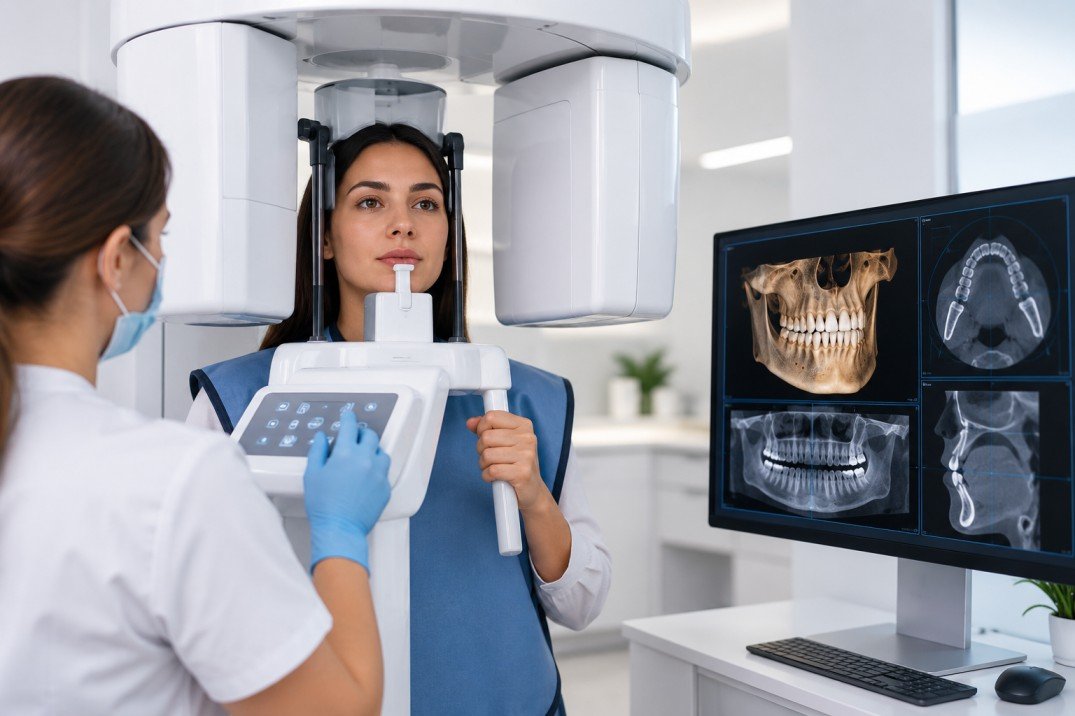
CBCT stands for Cone Beam Computed Tomography. In simple terms, it’s a specialized type of dental X-ray that captures a full 3D image of your teeth, jawbone, nerves, sinuses, and surrounding facial structures, instead of the flat, two dimensional picture you get from a standard dental X-ray.
Picture the difference between a photograph of a building and an architect’s 3D model of it. A regular dental X-ray gives your dentist a flat snapshot. A CBCT scan gives them a rotatable, measurable 3D model they can examine from every angle, above, below, and through the tooth or bone in question.
During the scan, a cone shaped X-ray beam rotates once around your head, capturing dozens of images in a single pass. Software then reconstructs those images into a detailed 3D model your dentist can study on screen, slice by slice if needed.
How Is a CBCT Scan Different From a Regular Dental X-Ray?
| Standard Dental X-Ray | CBCT Scan |
Image type | 2D, flat | 3D, rotatable |
What it shows | Basic tooth structure, decay | Bone density, nerve position, root shape, sinus proximity |
Best for | Routine check ups, cavity checks | Implant planning, complex root canals, surgical extractions, orthodontic assessment |
Scan time | A few seconds | 10-20 minutes |
A standard X-ray is often enough for a routine check up. A CBCT scan comes in when your dentist needs to see the full three dimensional picture, for example, exactly how close a wisdom tooth root sits to a nerve, or precisely how much healthy bone is available before placing a dental implant.
Why Do Dentists Use CBCT Scans?
CBCT imaging has become a standard part of planning for several common dental treatments, because it removes guesswork from procedures where precision really matters:
Dental implants – CBCT shows exact bone density, width, and height at the implant site, which determines implant size, angle, and whether bone grafting is needed first.
Root canal treatment – It can reveal hidden canals, fractures, or infections that don’t show up on a flat X-ray, which is part of why single sitting, microscope guided root canals are possible in the first place.
Wisdom tooth extraction – CBCT shows exactly how close an impacted wisdom tooth sits to the nerve running through your jaw, which affects how the extraction is planned and reduces the risk of nerve related complications.
Orthodontic treatment planning – For complex bite corrections, CBCT gives a full view of tooth roots, jaw structure, and airway, not just the visible crowns.
TMJ (jaw joint) evaluation – For patients with jaw pain or clicking, CBCT can capture the joint structure in detail that flat X-rays simply can’t show.
If your dentist has recommended a CBCT scan, it’s almost always because one of these procedures is being planned, not a routine add on.
Is a CBCT Scan Safe?
Yes. This is usually the first concern patients raise, and it’s a fair one. CBCT scans do use radiation, but at a significantly lower dose than a medical CT scan, in many cases, comparable to a short haul flight’s worth of background radiation exposure. The scan is also localized to the jaw and facial area rather than the whole body.
That said, a CBCT scan should be ordered when the diagnostic benefit clearly outweighs the exposure, not routinely for every patient. Most dentists reserve it for cases where a flat X-ray genuinely isn’t enough. It’s generally avoided or approached with extra caution for pregnant patients and young children, so it’s worth mentioning if either applies to you.
What Happens During a CBCT Scan?
The process itself is quick and completely painless:
Preparation – You’ll be asked to remove metal jewelry, glasses, and any removable dental appliances, since metal can distort the image.
Positioning – You’ll sit or stand with your chin resting on a support while the machine is positioned around your head.
The scan – The machine rotates once around your head in a slow, complete circle, capturing images as it goes. You’ll need to stay still, but there’s no discomfort involved.
Review – The 3D images are processed almost immediately, and your dentist can review them with you on screen the same day.
The whole appointment, including positioning, typically takes 15-20 minutes, with the actual scan itself lasting under a minute.
How Much Does a CBCT Scan Cost in Dubai?
Pricing depends on the area being scanned, a single tooth or implant site costs less than a full jaw or both jaw scan needed for orthodontic or TMJ evaluation.
Scan Type | Typical Price Range (AED) |
Small field (single tooth / implant site) | 350 – 800 |
Single jaw | 500 – 900 |
Full jaw / dual arch | 900 – 1,500 |
Full orthodontic or TMJ scan | Up to 1,500+ |
Some insurance plans cover CBCT scans when they’re medically necessary and accompanied by a referral, though basic plans covering only routine cleanings often don’t. It’s worth checking your coverage and asking your clinic for a written cost breakdown before your appointment, so there are no surprises.
Do You Need a CBCT Scan?
You likely need one if your dentist has recommended:
A dental implant, especially in the back teeth or an area with bone loss
A complex or repeat root canal
Surgical removal of an impacted wisdom tooth
Investigation of jaw pain, clicking, or TMJ symptoms
Detailed orthodontic treatment planning
You probably don’t need one for a routine cleaning, a simple cavity, or an uncomplicated single tooth extraction, a standard X-ray usually covers those cases.
The Bottom Line
A CBCT scan isn’t an upsell, it’s the reason your dentist can plan implants, root canals, and extractions with a level of precision that simply isn’t possible from a flat X-ray. If one has been recommended to you, it’s worth asking your dentist exactly what they’re looking for and how it will shape your treatment plan, rather than skipping the conversation.
Have a treatment coming up that involves a CBCT scan? Book a consultation with our team and we’ll walk you through exactly what the scan is for in your case, and what it means for your treatment plan.
Frequently Asked Questions
Yes. CBCT scans use significantly less radiation than a medical CT scan and are localized to the jaw and facial area. They’re generally avoided for pregnant patients and young children unless clinically necessary.
Prices typically range from AED 350 for a small, single tooth area to AED 1,500 or more for a full jaw or orthodontic scan, depending on the area imaged and the clinic.
The scan itself takes less than a minute. With positioning and preparation, the full appointment usually takes 15-20 minutes.
No. It’s completely non invasive, you simply sit or stand still while the machine rotates around your head. There’s no discomfort during or after the scan.
A regular dental X-ray produces a flat, 2D image. A CBCT scan produces a full 3D model of your teeth, jawbone, nerves, and sinuses, giving your dentist a far more detailed view for complex treatment planning.
It depends on your plan. Insurance often covers CBCT scans when they are medically necessary and supported by a dentist’s referral, but basic plans covering only routine care may not include diagnostic imaging. Check with your provider before your appointment.
No special preparation is needed, no fasting or medication changes. You’ll simply be asked to remove metal jewelry, glasses, and any removable dental appliances before the scan.
CBCT scans are generally avoided in young children unless clinically necessary, since their developing tissue is more sensitive to radiation. Your dentist will only recommend it if the diagnostic benefit clearly outweighs the risk.